Author Archives: mollyblieden3947

Fiddlehead Ferns with Garlic

In a departure from my typical New York Times repertoire I’m sharing a Molly Blieden original. Fiddlehead Ferns are only in season in April, and even then difficult to find and pretty pricey. But they are worth the annual indulgence- crunchy, slightly bitter and earthy- they pair nicely with olive oil garlic and salt. I used a pound of fiddleheads, 3 large cloves of garlic, and a tsp of salt. Sauté over high heat and keep tasting to make sure you don’t overcook. Enjoy this special taste of spring!

The Dispossessed, by Ursula Le Guin

The Dispossessed is a science fiction novel taking place on a pair of sister planets Annares and Urras. Written in 1974, the book is really a utopian fiction, an effort to reimagine a world unencumbered by poverty, capitalism, sexism, and the military industrial complex, while at the same time celebrating a varied continuum of sexual expression and a symbiotic relationship with the environment.

LeGuin gives us a lot to consider, but does not take for granted her reader’s understanding of the social problems she seeks to re-imagine. The book begins in the revolutionary Socialist land of Annares which had been settled 200 years ago by Settlers seeking relief from poverty and oppression on Urras. We follow Shevek, the protagonist and prodigy physicist as he struggles to find balance between the demands of his society – shared assignment to the drudgery jobs, communal living, fear of “egotizing” or being an individualist – and his desire to study physics. Through Shevek’s eyes we see the respect granted to women colleagues, his open and honest sexual life, and his freedom of movement in a society with with no sense of possession.

In my book group it was pointed out that writing a pro-communist novel at the height of the Cold War was a radical act. The context of 70s experimentation with free love is also quite evident (the book was written in 1974).

Shevek runs up against petty burocracy and decides to take the radical step to leave Annares to visit Urras. On Urras he is given access to labs, students, books from other worlds, and the riches of capitalism. But he is horrified by the inequality and baffled by the artificiality of their culture, and ends up escaping his handlers at the University to seek out the revolutionaries of Urras. It doesn’t take long before Shevek’s symbolic role as the visitor from radical Annares sparks the growing waive of discontent and protest erupts.

Shevek manages to escape and in the end returns to his family and culture on Annares, a changed man. Whether Annares has changed enough in his absence to welcome his return we do not know.

This description only skims the surface of this very dense book. I found the description of the utopian Annares a little tedious at the beginning, where each character seemed a trope for some social ideal. But as Shevek’s tale unfolds the characters become more complex and his struggle for integrity as an intellectual, a loving partner and father, and a citizen made me question my own egotizing and propertarianism.

One aspect of the book that might take me more than one reading to fully understand is Shevek’s musings on physics and the philosophy of simultaneity. This one passage is probably the clearest explanation and beautifully conveys these ideas.

“It is only in consciousness, it seems, that we experience time at all. A little baby has no time; he can’t distance himself from the past and understand how it relates to his present, or plan how his present might relate to his future. He does not know time passes; he does not understand death. The unconscious mind of the adult is like that still. In a dream there is no time, and succession is all changed about, and cause and effect are all mixed together. In myth and legend there is no time. What past is it the tale means when it says ‘Once upon a time’? And so, when the mystic makes the reconnection of his reason and his unconscious, he sees all becoming as one being, and understands the eternal return.”

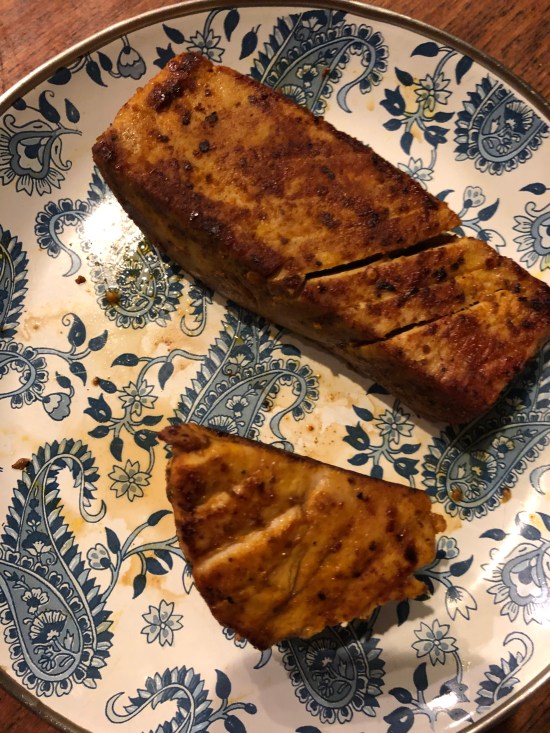
Tuna Steaks Moroccan Style by Pierre Franey

A few of the steaks were eaten before I had a chance to photograph this! It was very good- a nice change from the usual soy/sesame seasonings I use for tuna steak. I used only half a tsp of paprika and added half a tsp of sumac but otherwise followed the recipe. Main challenge for me was cooking the tuna enough but not too much. I used a pan on the stovetop but next time might try the broiler.

Blackfish City by Sam J. Miller

Blackfish City is a speculative fiction novel set well into our global warming future. The seas have risen, coastal cities flooded, and the world awash with millions of refugees escaping their failed governments.

An industrious group of “shareholders” have created a new city on the sea, Qaanaaq, using oil rigging technology for the foundation, and a geothermal ocean vent for heat and power. In creating this completely new future world, Miller is tasked with not only telling us a story, but also making us understand and believe in this world with all it’s strange architecture, new technology, and political history. At times the primary narrative gets lost in the weeds of context.

The narrative is told through successive chapters, each devoted to the story of a different character and told from their first person point of view. The characters reappear in the 9 sections and by the end of the book we understand how their lives are connected.

Blackfish City is a meditation on family and connections of blood and memory. The future families of Qaanaaq have a much greater variety of gender and species, the result of scientific experimentation connecting people and animals through nanotechnology. This is interesting in concept but Miller devotes so much time to explaining these relational complexities that we get a little short-changed in the character development. At one point in the book, for example, two characters learn they are parent and child. Until that moment I had thought these characters were the same age.

All these stumbling blocks make it difficult to become fully engrossed in Miller’s vision, one which is both a dystopic warning against continued environmental plunder and a utopian future which redefined family, gender and species. The complex questions posed by this vision are never given chance to flourish. At the end of the novel, Masaaraq, one of the mother figures quips, “Home is where we make it. Where we’re together.” After a novel full of explicating the particular challenges of this particular future, this generic ending is a disappointment.

My Mom’s Vegetable “Meatloaf” with Chevan Sauce, by Giada de Laurentis

This is a departure from my NYTimes recipe repetoire – I found this one on Epicurious. It is pretty tasty but really hard to get out of the pan without the whole thing falling apart. Putting the finished cooked loaf in the fridge to cool before cutting (then reheating) helps. If I made this again I would probably add a handful of walnuts to vary the texture. But in spite of all my comments it was still quite tasty.

I should add that I injured my knee over the weekend and could not have made this at all without my good friend Tanya, who kept me company all afternoon in the kitchen and let me order her around while I sat at the table, feet up, chopping away. It made me acutely aware of the physicality of cooking and thankful to have such a good friend to serve as my legs in my time of need. It is definitely something to pay forward.

The Water Cure by Sophie Mackintosh

Reading this book is like having a dream which fills you with a growing sense of dread. At first it is the unexplained toxic event which we are made to understand as the reason this family has isolated themselves in a remote waterfront compound. Then the three sisters start describing the strange “treatments” and cures designed to keep them healthy and rid of the toxins. Drinking glasses of salt water until you vomit. Being sewn into burlap sacs and put in the sauna until you pass out. The “drowning game” where you are held under water in the pool. As the tale evolves, the home which first seemed a refuge from a dying world, becomes a sinister prison from which three girls are unable to escape. Truth in this book is a fleeting notion, with multiple narrators redefining who is I and who is you and what screwy things we do to each other in the name of love.

The Alexander Cipher and the Exodus Quest by Will Adams

After reading Homegoing and Don Quixote I was ready for a quick fix, and these two thrillers by Will Adams fit the bill. Both novels are archaeological mysteries of the looking-for-treasure-in-a-hidden-tomb variety, with lots of bad guys with guns in exotic settings. The main character, Daniel Knox, is an American ex-pat archaeologist who has settled in Egypt to pursue his career while making a little side money as a diving instructor. In
Alexander Cipher he gets hopelessly embroiled with gangsters, Macedonian Extremists, and corrupt Egyptian bureaucracy. In Exodus Quest he is accused of murder by the third chapter, while his girlfriend, fellow archaeologist Gaille Bonnard, is kidnapped a few chapters later.

As it happens, the archaeological mysteries in these books are not fiction, and Adams goes in to quite a bit of detail about the different theories of where Alexander the Great is buried with all his treasures and the history of the Essenes and the Jews in Egypt. So if you are an amateur Egyptologist and like a good mystery, these books are for you. Actually my only complaint is that it seems the rest of the series is not yet available in Kindle version, otherwise I would surely be whipping my way through Book 3: The Lost Labyrinth.