Author Archives: mollyblieden3947

Station Eleven: A Novel, by Emily St. John Mandel

This book could be the ideal or the worst book to read in the midst of a pandemic, depending on your anxiety level. The story takes place in a future present time, during the eruption of a “Georgia Flu” Pandemic and takes place primarily in the Great Lakes Region of the US and Canada. The Georgia Flu is more deadly than the Coronavirus – 4 hours from infection to the onset of symptoms and 1-2 days to death. In a short period of time 99% of the population dies. So either you could read it and be relieved that our Pandemic is not as serious as the Georgia Flu (which is how my book group colleagues responded) or you could read it and fear for the worst about your current situation.

The narrative starts on Day 1 of the Pandemic, with a performance of King Lear in Toronto, during which Arthur Leander (the actor playing the title role) has a heart attack and dies. Jeevan Chaudhary, an EMT and friend of Arthur’s, was sitting in the front row and rushes on stage to try to resuscitate him, but it is too late. As the EMT’s take the body away Jeevan leaves the theater and is wandering the streets of a snowy Toronto in a daze when he gets a call from a doctor friend about the Flu outbreak in his hospital. The doctor tells him to immediately pack and leave the city. Jeevan picks up on the urgency of his friend’s voice and buys 7 grocery carts of food and supplies to bring to the apartment of his handicapped brother Frank. The two ride out the beginning of the pandemic (and the death of Toronto) from his 10th floor apartment window.

The narrative leaps back and forth in time from the King Lear performance on Day 1 of the Pandemic, with occasional extra-diegetic warnings inserted such as “everyone at the bar will be dead in 2 weeks”. What seems like a random assortment of characters, we learn are in fact all loosely connected to Arthur. The story is like a fabric which comes unraveled and then is knitted back together by the end.

Among the characters from Arthur’s past are his first two wives, Miranda and Elizabeth. Miranda is an artist whose life passion is a graphic novel project about a space station named Station Eleven. The story within a story provides a sci-fi mirror to the otherworldly events on earth, and also serves as a device to connect characters. Station Eleven has rescued a group of earthlings from the planet’s natural destruction, but in their escape the station was damaged so it’s always twilight. Factions emerge among the Station Eleven inhabitants between those who want to return to Earth and those who know there is no return.

Another story within the story is the series of letters Arthur writes to his childhood friend “V”. V later sells the letters and publishes them. V never responds to Arthur’s letters so they become an autobiographical view on Arthur’s life.

The future narrative shows post-pandemic life – small towns become strongholds for rural living with collective security measures in place. The conductor of the army orchestra forms the Traveling Symphony which wanders from town to town performing music and Shakespeare. In the troupe is one of the child actors from Arthur’s King Lear performance. Another group of survivors have colonized an airport in Michigan. The group ends up at this small airport after their flights on Day 1 of the Pandemic were re-routed and grounded. Some of these passengers had been on their way to Arthur’s funeral in Toronto. A religious group following “the Prophet” travel from town to town terrorizing residents and stealing their weapons. This group also has a connection to Arthur which I will not spoil for my readers.

A delightful aspect of fiction is that in a world where 99% of humanity has succumbed to a virus, so many characters and plot lines can come together at the end. This is especially comforting from the perspective of a New Yorker stuck in a quarantine with no end in sight. The book also wraps up with a note of hope – Electricity has re-emerged in Chicago – a grid of streetlights appear on the distant horizon. Despite the devastating losses, humanity has preserved its knowledge and basic technology. Station Eleven is a beautifully written novel, and even if you must wait until after our own Pandemic to read it, it will be worth the wait. I rate this book  a 4.5 👍 out of 5👍.
Weather: A Novel, by Jenny Offill

Weather is a book written in short vignettes like a long poem in verse. That “A Novel” is part of the title seems almost a point of clarification, to assure the reader that this ephemeral narrative will meet the expectations of the genre.

A writer friend I know keeps a journal with detailed observations from her everyday life. This book reads like that journal, filled with delicious snippets of the overlooked and unexamined. The narrator works in a library and is privy to an ever-changing cast of characters who visit and work around her.

“Also in the air: a coworker who has taken to carrying X-rays around in her purse. Some kind of medical mistake. It can’t be undone, but it can be recounted.”

Interspersed with the vignettes are some very quirky jokes, not all of which I understood.

The story itself is told from the perspective of Lizzie Benson, and describes her life with her husband Ben (a philosophy PhD who makes money as a coder) and son Eli (whose New York public school drop offs each morning are an encounter with otherness). The book takes place just prior to the last presidential election, so the volatile political environment is background to the narrative. The changing Weather marked by the title is both environmental and political.

Lizzie has a very close relationship with her brother Henry, a recovering substance abuser who struggles with depression. Their relationship is endearing, including the little tricks Lizzie employs to support him and keep him alive from day to day.

In Weather, the future is uncertain; the war photographer comments on the nature of countries about to erupt in war (“hackles up”), the environmentalists say there is no where to relocate to keep your family safe in the inevitable climate catastrophe to come, Eli’s uncomfortable questions about death are diverted and unanswered. The counterpoint to this temporal anxiety seem to be the everyday acts of kindness and a present-focused living. A driver with a car service Lizzie uses is getting forced out of business by that “other company” so Lizzie starts taking his cars everywhere and wonders if she is his only client. Her mother buys socks for the homeless which she hands out with dollar bills. She takes in her brother after his marriage falls apart, and stays up late with him each night brainstorming greeting card ideas to distract him from the depression.

Just as this story resides very much in the present, the ending comes almost arbitrarily. At first I found this unsettling, but have come to understand this as consistent with Offill’s present-centered focus. Though short, the book covers a lot of ground and I would give it a 4.5 👍 out of 5👍.

No Knead Bread by Mark Bittman

I’ve never made bread before, and like so many quarantined foodies this seemed like a good time to try. This is really a miracle bread- I even go both my kids to make it- we’ve made 5 loaves so far! It’s very easy and forgiving.

Step 1:

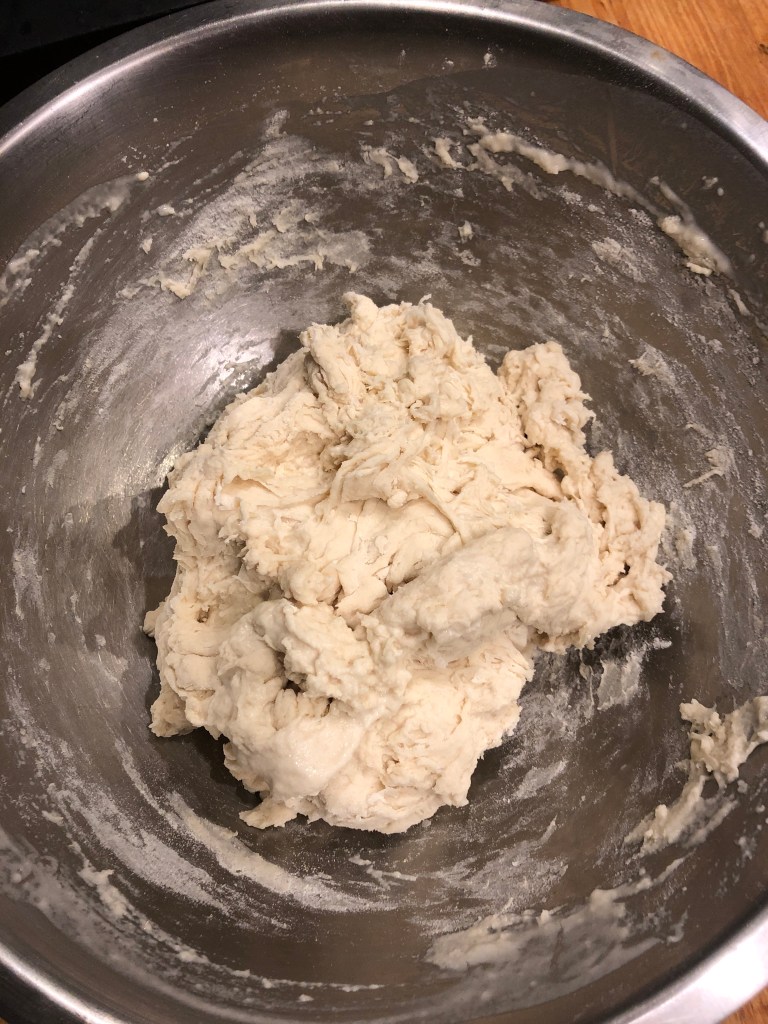
Mix 3 cups flour, 1 1/4 tsp salt and 1/4 tsp instant yeast in a large bowl with your hands. Then add 1 5/8 cup water and mix to incorporate with your hands. It will be sticky. Cover bowl tightly with plastic wrap and let sit somewhere warmish for 12-16 hours.

At the end of step 1 the dough looks like this.

Step 2

Your dough should have expanded and bubbled. Cover a flat working surface and your hands with plenty of flour. Lay a dish towel next to your working area and cover it with cornmeal. Using a spatula pour the risen dough onto your floured work surface. Pat some flour on top so it’s not too sticky to handle. Stretch one side of the dough out then fold it over the top and give it a pat. Do this on all four sides. Then pick up the whole dough and put it on your cornmeal covered towel. Fold the towel over and let sit for 1.5 hours.

Step 3

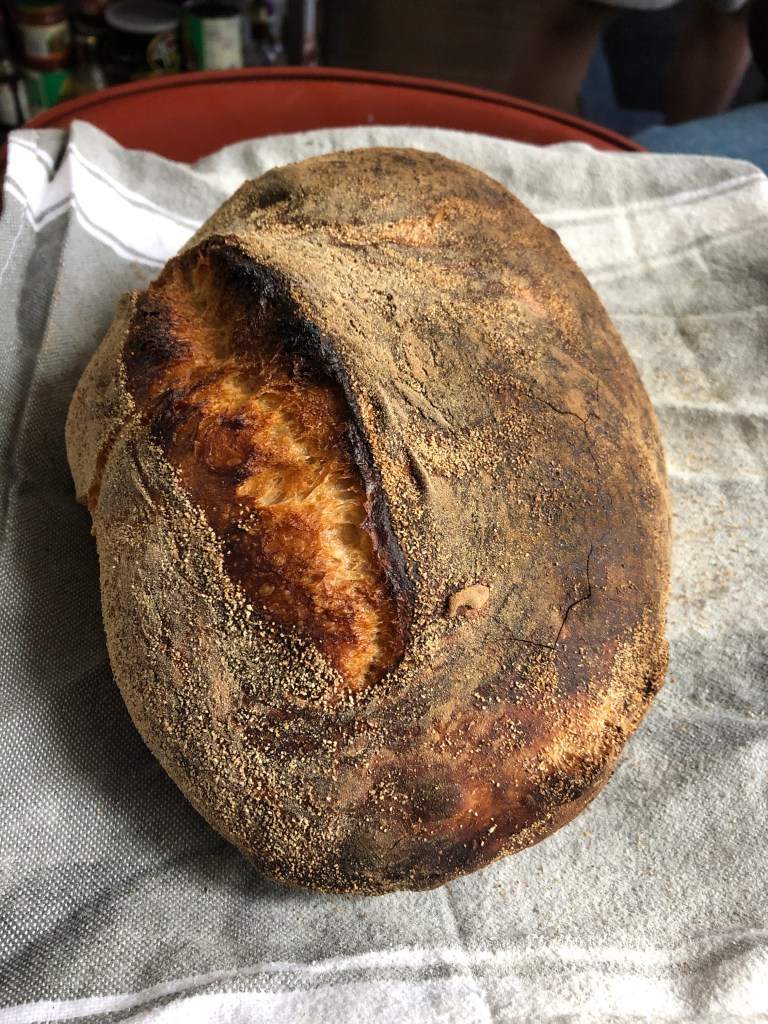
1 hour after covering the dough above turn on your over to 450 degrees and stick a 6 quart Dutch oven in it to warm for 30 minutes. After 30 minutes pull it out, remove the lid, and dump your dough on the bottom. You can shake it a little if it doesn’t land straight. Put the lid back on and return to oven for 1/2 hour. After a half hour remove the lid and cook another 5-15 minutes to desired shade of brown. Remove and cool on a rack. Voila!

My next project is to try to add black cured olives to the above and make olive bread. I’ll let you know how that goes.

Israeli Couscous with Chick Peas and Spinach, by Molly Blieden

This was an impromptu side dish using ingredients from the cupboard that was a huge success.

Ingredients:

1 1/3 cup Israeli Couscous

1 small onion chopped

3 cloves garlic

1 can Garbanzo Beans

1 package of chopped spinach

1 can diced tomatoes

1 1/2 tsp cumin

1/2 tsp sweet paprika

1/4 tsp cayenne pepper

1/4 tsp turmeric

Salt and pepper to taste

Directions:

Bring 1 3/4 cups of water to a boil and cook couscous according to the package directions. Simmer for no more than 10 minutes – you want to err on the side of al dente.

Meanwhile thaw the spinach in a pan over medium heat then set aside.

Sauté onions 3 minutes on medium high heat until softened. Add chickpeas and cook 5 more minutes. Add tomatoes, garlic, cumin, paprika, turmeric, and cayenne. Stir well to combine.

Mix in couscous and spinach. Serve warm with a dollop of plain Greek yogurt. Enjoy!

Middle Eastern Pita and Vegetable Salad by Martha Rose Shuleman

I made this salad last night and it is now my favorite. The combination of creamy yogurt, tart lemon, and crunchy vegetables and pita are my dream salad combo. I made a few modifications as noted below:

For the Salad:

-4 Persian cucumbers, cut in half lengthwise and chopped in moon shaped slices

-1 lb grape tomatoes sliced in half

-6 scallions sliced thin, white and light green sections

-1/2 cup chopped parsley

-1/4 cup chopped mint leaves

-White inside leaves of head of romaine sliced thin

-4 cups of chopped arugula

For the Dressing:

-1 clove of garlic minced

– Juice of one lemon (approx 1/4 cup)

– 1/4 cup olive oil

-1/4 cup of plain yogurt

For the Topping:

1 pita bread toasted and cut into matchstick shaped pieces.

Mix all the salad ingredients. In a separate jar or bowl mix the dressing ingredients and let sit so the garlic permeates. Toast and cut the pita then let cool. Toss the salad ingredients with about half the dressing then slowly add more to taste. I had about 1/3 cup left over. Salt and pepper to taste. Add pita and toss again before serving. Enjoy!

Age of Myth, by Michael Sullivan

This is book one of a fantasy fiction trilogy set in Erivan and Rhulin, a land of men and magic. The world of Rhunes and Fhrey is characterized by the extraordinary abilities of the Fhrey who live thousands of years, and the struggles of the Rhunes, who are seen by the Fhrey as uncivilized animals. Within the Fhrey there are also divisions, with the Miralyith tribe, masters of the magical Arts, the most powerful. Some Miralyith see themselves as god-like creatures and even distain the other Fhrey as lowly and beneath them.

Like many fantasy epics this is a story of social justice, dressed in garments dissimilar enough that we don’t recognize the tale as our own. A few members of the most remote tribes of the Fhrey unite with the Rhunes to fight the Miralyith oppressor. Their success is lead by our female hero Persephone, who breaks the tradition of her village to become the first woman Chieftain, a clearly feminist side story.

But for the most part I don’t read fantasy fiction for its social justice subtext (although I expect and appreciate it in the books I prefer). I read it to take a break from the stress of the real world where there are no magical solutions to my mundane problems. The best stories are written with the most conviction and detail, and the invented landscape, languages, and belief systems present seamlessly to transport the reader into the story. In other words, there is enough detail to transport the reader into the story but not so much detail that every five pages I have to look at the map at the beginning of the book or the glossary at the end to figure out where I am and what is going on.

Based on these basic criteria I give Age of Myth 3 1/2 👍 out of 5 👍. The story is not as intricate as some in this genre, and a little predictable, but well written and poetic. I’m looking forward Age of Swords, the next book in the series.

Where The Crawdads Sing, by Delia Owen

The Marshy coastal region of North Carolina where this story takes place is nothing like the gritty urban neighborhood where I live. The solitude of life in the marsh and its rich biodiversity, are almost unimaginable as I sit reading on the subway every morning, shoulder to shoulder with my fellow New Yorkers. But Delia Owen tells a captivating story of how one little girl left with nothing builds a life out of communion with her environment.

Catherine “Kya” Clark, the youngest of 5 children, grew up in a shack among the “Marsh People”. Shunned by the local townsfolk for their isolated ways, the weekly walks into town for provisions were a source of terror and humiliation. When she was 7, her mother walked out of the house and down the road, never to return. Following the departure of her mother, her four siblings slowly escaped leaving Kya alone with her alcoholic father. When she was 10, her Pa left too, leaving Kya in the marsh to fend for herself, 3 miles from the nearest town.

Truant officers, orphanage staff, and well meaning adults reach out to Kya but she has an understandable mistrust of others and a lifetime of practice hiding from adults. Her one adult connection becomes Jumpin’- the Negro gas station manager who gently keeps her alive by buying her bags of mussels collected from the shore, and selling her supplies in return.

Tate, a friend of her brother’s, enters her life by leaving her exotic feathers on a stump by her shack. After all of Kya’s struggles the reader cheers Tate on and he provides some of the nurturing companionship Kya desperately needs. Kya and Tate share a love of the natural world and explore the marsh, collecting shells and observing flora and fauna. Tate teaches her to read and starts bringing her books. As Kya masters reading, her keen interest in her environment takes an academic turn and she starts making detailed studies and observations of the creatures and grasses around the Marsh.

But there are two narratives in this novel; one which starts in 1952, when Kya’s mother walks out of the house, and follows Kya’s struggles to survive and keep her life in the marsh. The other story begins in 1969, with two boys on their bikes finding a dead body at the foot of an abandoned fire tower in the Marsh. The boys run to get the Sherrif and the investigation into the death of Chase Andrews begins. The narrative goes back and forth between these two stories, and their inevitable collision brings a growing sense of dread.

I’ve only scratched the surface of this remarkable book, filled with intricate descriptions of bird mating rituals, poems by Galway Kinnell, meditations on solitude and the desire for connection. It is also a compelling read right up to the end. Of a total of possible 5 👍 I would give this one 5👍👍👍👍👍.

Mission Critical, by Mark Greaney

Mission Critical is the eighth book in the Gray Man series. These are books fueled by pure adrenaline. This one takes it up a notch with its focus on biological weapons; just what you want to be reading during the outbreak of the Coronavirus.

If you’ve never dipped in Gray Man before, the books chronicle the blacker than black ops of the CIA. If you like spy stories set in exotic locations these books are for you.

Mission Critical is set in Scotland – a little less exotic than some of the other Gray Man books. A rogue North Korean scientist and secret agent has teamed up with her Russian counterparts to take down the western intelligence community who are all attending a conference in Edinburgh. Court Gentry, the Gray Man, accidentally finds out about this and soon becomes an integral part of the case.

If I told you any more about the plot I’d have to kill you so you’ll have to read the rest yourself! Rating this book within the Spy Thriller Subgenre, of a total of possible 5 👍 I would give this one 4 👍👍👍👍!

The Magister Trilogy, by Celia S.Friedman

The Magister Trilogy is an epic fantasy series based in a world where expending magic comes at the cost of one’s own life force. Those with magical abilities only have a limited amount, and once expended, they expire. The magical exceptions are the Magisters, a secret group of male witches with an undying athra (or magical force).

It turns out that secret source of the Magisters’ life force is their ability to remotely feed on others’ life forces. Mere humans suddenly become afflicted by the mysterious “wasting disease” while they are slowly drained by the Magisters, who deliberately remain ignorant of their hosts (“consorts”). Early in the series we learn that Prince Andovan, son of one of the most powerful rulers in the world, has suddenly become inflicted by the Wasting Disease.

This is surprising to all the Magisters, because it defies the Magister Oath. The Magisters keep to a code of ethics to temper their more base instincts – they are fiercely territorial and cannot stand being within proximity to others of their kind, but they each have the power to flatten armies and destroy kingdoms single-handedly. Accordingly they have made an Oath that if one Magister is retained by a royal house, the others will leave their employers alone. Thus since King Danton is served by the powerful Magister Ramirus, his son Prince Andovan should be off limits to other Magisters as a consort.

It is against this complex web of magical stage-setting that we are introduced to Kamala, the talented witch with magical Sight, who doggedly seeks out a male Magister mentor, and convinces him to train her. She survives her training to become the first female Magister.

Siderea, the Witch-Queen of the Free Peoples, has stayed in power longer than any witch should last due to her secret manipulations of her many Magister lovers, who help keep her alive.

Gwynofar, Queen of the High Kingdom and wife of King Danton, pursues the religious rituals of her native Kierdwyn, convinced of the inner power of the Lyr people who will supposedly rise up to protect the world when the evil Ikati reappear. While ridiculed by the High Kingdom court and even her husband, she remains dedicated to the Lyr mythology.

While this series has many of the traditional elements of epic fantasy – magic, dragon-like creatures (Ikati), secret invaders, and epic quests – it is also a feminist story. The main female characters – Kamala, Siderea, and Gwynofar – are women of power trying to break into a boys club. To some extent the series tracks their individual successes and creative problem-solving, as they kick ass and change the world. Friedman’s female characters are complex and interesting to follow, and it is refreshing to have the women take the spotlight.

I haven’t been rating the books I review but think it might be helpful to add this feature to my reviews. Of a total of possible 5 👍 I would give this one 4 👍👍👍👍!