
Yankee Stadium, NYCFC v Columbus Crew
Leave a reply

This is a delicious salad made with raw Zucchini – plentiful this time of year. I used homemade pesto rather than basil leaves but otherwise followed directions.
I have never felt so inside the head of a writer as I did while reading this book. In fact I was so confused by the blurring of autobiography and fiction, (a confusion I found somewhat pleasurable, I might add) that I wanted to write this entry before reading any of the reviews about the author or book so I could preserve the immediacy of my impressions. Even seeing the author’s picture at the end of the novel was somehow a distraction.
Nunez deliberately lays out this path of blurred boundaries with clues along the way. In Part Eleven, an extra-diagetic chapter where she describes her fantasy ending to the novel, and gives us another version of the “true story”, she comments: “She tells the man about a new course she’s teaching. Life and Story. Fiction as autobiography, autobiography as fiction.” This course is the novel. The novel is the course.
The book does have a plot. The narrator, a writer, has learned that her good friend and mentor has committed suicide. His wife has asked if she will take in his Great Dane. The dog is also grieving the death of his owner, and makes terrible sobbing sounds when left alone. The narrator lives in a rent-controlled small apartment where dogs are not allowed. But she cannot say no, and takes the dog in. He soon takes over her bed and her heart and her life. The only character in the novel with a name is the dog, Apollo.
The narrator-writer sees literary references in all her thoughts and experiences, and beautifully interweaves these references in the story in a way that seems utterly relevant and not heavy handed. From Rilke’s Letters to a Young Poet: “‘Perhaps all the dragons in our lives are princesses who are only waiting to see us act, just once, with beauty and courage. Perhaps everything that frightens us is, in its deepest essence, something helpless that wants our love.’ Words often quoted, or paraphrased, including recently in an epigraph to the film White God: Everything terrible is something that needs our love.”
I am not a writer and it is not my sole passion to make sense of my experiences by committing them to words. The act of writing this blog is the closest I come to that struggle, which gives you some idea of how far away I really am. But Nunez brings the reader along in her struggle. Every moment is a literary moment; expansive, considered, connected through language to other stories. What is the truth and what is fiction becomes irrelevant to the larger project of observing and writing and trying to find meaning in life and art.

NYCFC v North Carolina FC, US Open Cup
Goodbye, Vitamin is the charming story of Ruth, who returns to her childhood home for a year to help with her father who is in the early stages of dementia. The novel takes the form of a journal, with entries marked by date recording her observations of the life swirling around her.
Outside the Laundromat, two drunks are sharing a cigarette. The man has a hand tenderly cradling the back of the woman’s head, which she appears to enjoy at first, before she begins to resent it.
“You think it’s lumpy,” she says, pulling away, suddenly. “You think my head is lumpy.”
“I don’t think it’s lumpy,” he says.
“You do,” she says. “You think it’s lumpy.”
“Baby, I love your head,” he says.
“You’re saying I’m not smart,” she says. “Is that what you’re incinerating?”
He says, “I’m not incinerating a thing.”
These entries have a parallel in a journal Ruth is given by her father when she first returns home, recording his observations of her as a child trying to make sense of the world. Each entry is told from the father’s perspective (“I”) about Ruth (“you”).
Today you asked why it was that people say cloudless but not cloudful. Today you made clear that you did not know there was a difference in the spellings of “pitchers” and “pictures.” You scraped seeds off of bagels and planted them in the flower bed out front. I didn’t have the heart to tell you that there’s no such thing as a bagel tree.
As the story develops, Ruth’s entries become centered around her father. The narrative voice switches, as she takes over the adult “I” and he fills in the childlike “you.”
Today I gave you my old seashell collection. You arranged all the shells at the bottom of your fish tank in a pretty way.
“Thank you for the exoskeletons,” you said to me.
“You’re welcome,” I said to you.
The novel makes an adventure out of everyday life, with small moments becoming the milestones. Time seems to stand still while Ruth navigates the changing cognitive abilities of her father, his evolving relationship with her mother, and her own mourning of a failed relationship which prompted her return home. Ruth seems like a spectator to her life, observing with wonder, but without judgement, the life around her. As her father’s doctor advises,
“There’s nothing really to ‘do,’ he says, just be present.”
“Like in the moment” I say.
“I meant ‘around,'” he says. “But sure, that, too.”
Woody Allen wrote that showing up is 80% of life, but Khong shows us you can reach 100 by showing up and paying attention. Her quiet observations inspire one to live in the present and savor each moment for its singularity.
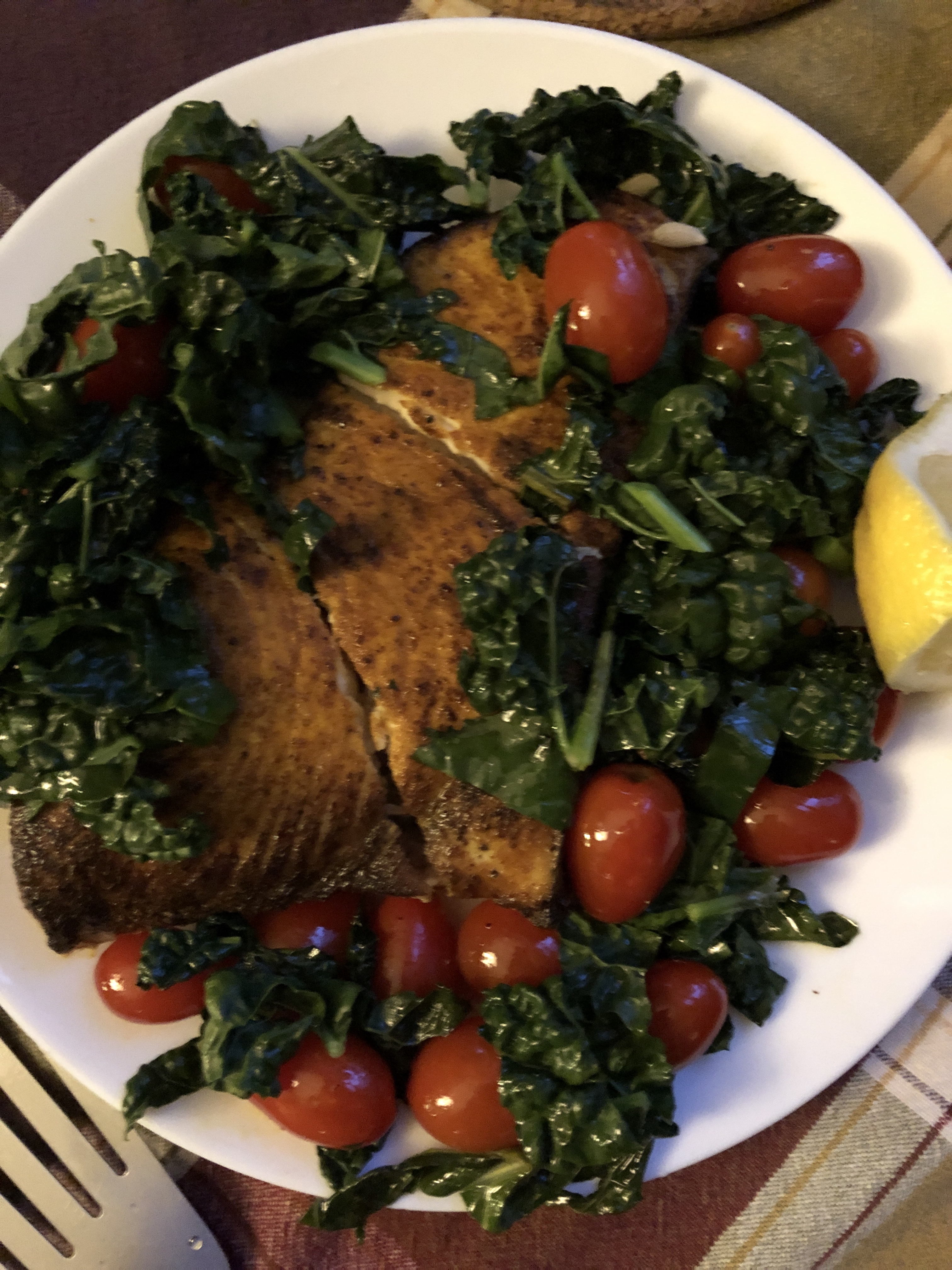
Even though I didn’t follow it exactly, this is a great recipe which produced a very moist flavorful swordfish. I’ve cooked my share of dry swordfish so this was a game changer as far as I’m concerned. The original recipe was supposed to be served on garlic toast but I skipped that part and added a few ingredients. Following is what I did:
Make a dry rub with the following:
1 Tbsp Curry
1 Tsp Paprika
1 1/4 Tsp Salt
1/4 Tsp Black Pepper
1/4 Tsp Tumeric
Pinch of Sumac
Mix together and rub generously all over the fish.
Heat 2 Tbsp olive oil in a pan over medium high heat. When the oil is hot put the filet in and cook on one side for 3 minutes without touching it. Then flip the fish.
Cut up half a bunch of Lacinto Kale (you can substitute other greens like chard or mustard greens). This makes about 2 heaping cups.
Put the kale and 1 1/4 cup of grape tomatoes on the fish and cover with a lid. Cook for 5 minutes.
Plate and squeeze lemon over the whole dish. Delish!
Sorry for the lag in my book reviews but I went on a binge, reading all 8 books of the Expanse series. (Unfortunately I have to wait another year for the final book 9.)
The Expanse is set in the future, in a time when speculative new technologies, combined with our continued environmental degradation of Earth, have lead mankind to explore habitation on Mars and the outer planet moons and asteroid belt. Corey explores the biological and social implications of the cultures which would emerge from low gravity living. Tensions between the residents of the outer planets “the Belters” and the inner planets sparks the initial conflict of the book. The Canterbury, an Ice freighter which harvests ice from asteroids and brings it to the Belt to use for water, is blown up by ships which appear to be Martian military vessels. Four crew members survive and broadcast their suspicions of Mars’ involvement to the universe, just before they are picked up by a Mars military vessel. The crew members – James Holden, Naomi Nagada, Alex Kamal, and Amos Burton – form the central cast around which the series is based.
Like any epic fiction, the narrative is pretty complex, exponentially more so in this series due to the imagined technologies, life forms from other planets, and the changing laws of physics. Like many speculative fictional novels, new technologies influence not only how we relate to people on other planets, but also how we relate to each other. New reproductive technologies radically alter the concept and function of family. For example Holden grew up with 8 parents (all somehow biologically involved); families are mixes of gender and genetics, families are constructed, not predetermined. In many ways the future is dark and frightening, but the social fabric is progressive and liberating.
Syfy channel made a series based on the books that is dark and gritty and moves at the same slow mysterious pace as the novels. I’ve only watched a few episodes but they are intriguing. The complex imagined worlds are kept visually minimal – like the novels you don’t fully understand what you are looking at and the world gradually reveals itself to you as the story evolves.
But the books are really what I could not put down, and look forward to the final chapter due to come out next year
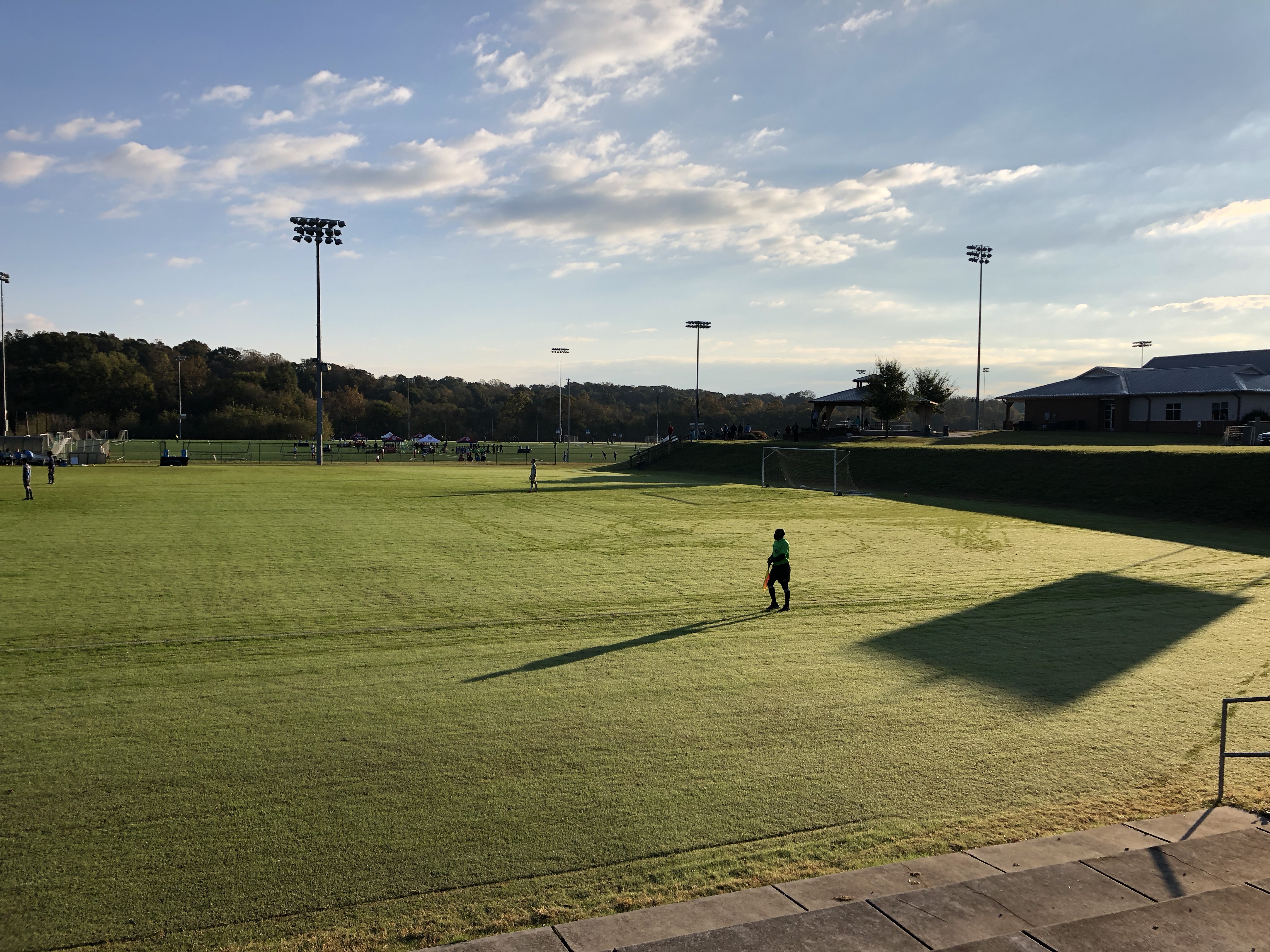
Regional US Soccer Development Academy Showcase, 2018
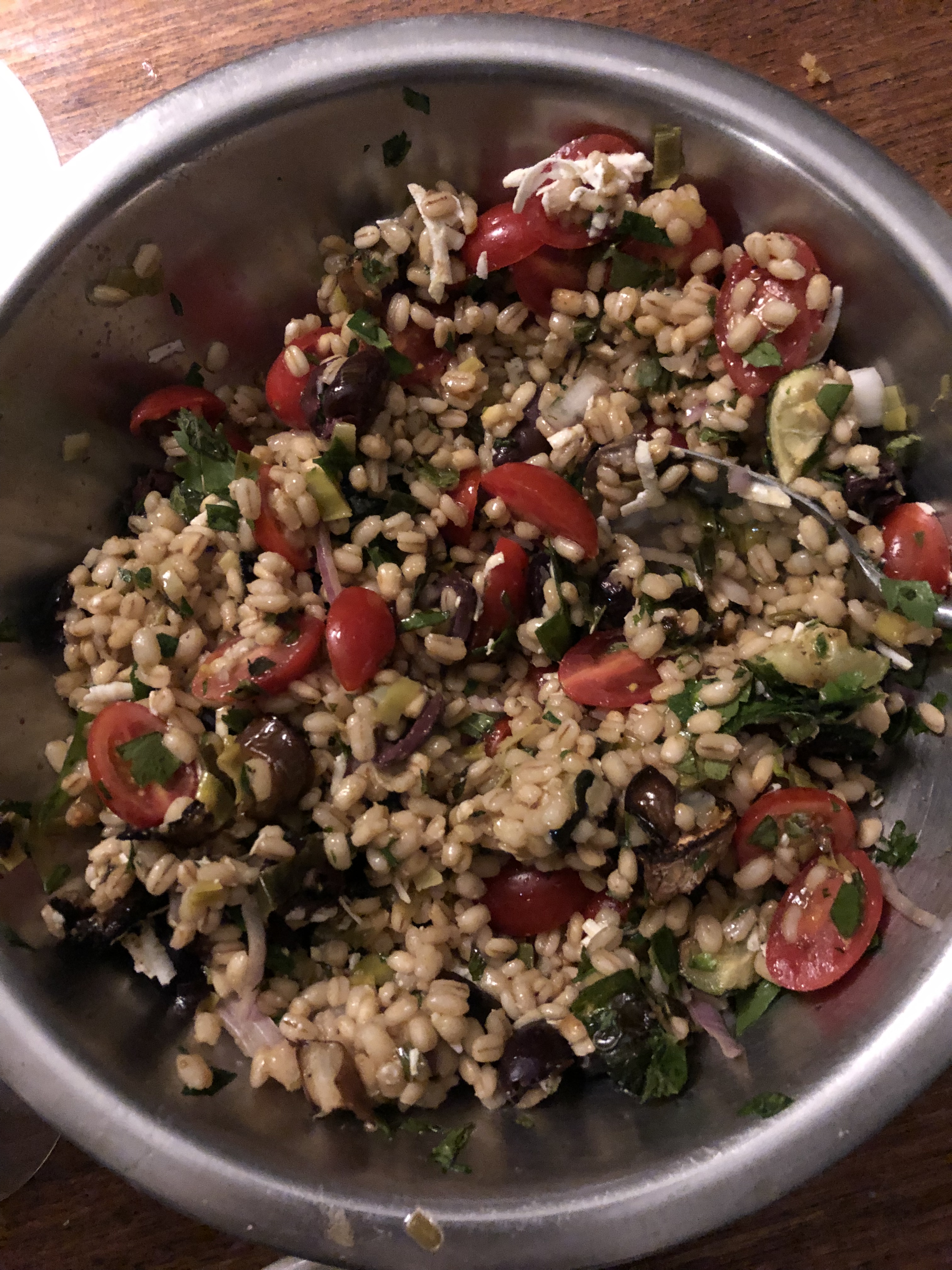
This is a salad which is a meal, with subtle flavors from the cumin, coriander and cayenne added to the broth in which the barley cooks. Leftovers keep well for a mid week snack.
1 medium eggplant cut into 1 inch cubes
1 small zucchini cut into 1/2 inch rounds
EVOO
1 tsp salt
1 tsp pepper
1 cup chopped scallions
1.5 tsp ground cumin
1/2 tsp ground coriander
1/2 tsp cayenne
1.25 cups pearl barley (8 OZ)
1 14 oz can of chicken broth
3/4 cup water
2 tbsp fresh lemon juice
1 clove garlic minced
1/4 tsp sugar
1/2 lb of cherry tomatoes halved
1/3 cup Kalamata or other black olives
1/2 cup thinly sliced red onion, rinsed and drained if desired
1 cup chopped fresh flat leaf parsley
1/2 cup chopped mint
1/3 cup shaved ricotta salata
Preheat oven to 425F. Toss the eggplant and zucchini with 5 tbsp oil, 1 tsp salt, and pepper. Line a cookie sheet with parchment paper and spread eggplant and zucchini on sheet. Roast 20-25 minutes until golden brown and tender. Remove from oven and let cool.
Heat 2 tbsp oil in heavy pot over medium-high heat until hot, then add scallions, cumin, coriander, and cayenne and stir for 1 minute. Add barley and stir until well coated 2 minutes more. Add chicken stock and wter and bring to a boil. Reduce heat and simmer, covered 30-40 minutes. Remove from heat and let stand 5 minutes. Transfer to flat sheet and let cool about 20 minutes.
Whisk together lemon, garlic, sugar, salt, pepper and 3 Tbsp oil in large bowl. Add cooled barley, roasted vegetables, and remaining ingredients. Scatter ricotta salata over top.

This is another Molly Blieden original, inspired by the relish in Bottino’s Tuscan Tuna Salad in Chelsea, New York.
Ingredients:
1 small fennel bulb sliced thin (with a mandoline if you have it)
1/3 cup green pitted Cerignola olives
3 stalks of celery cut thin at an angle
1/8 onion very thinly sliced
1/3 cup olive oil
1 tsp red wine vinegar
1/2 tsp mustard
Whisk the vinegar and mustard and olive oil. Combine the fennel, onion, olives and celery in a large bowl. Drizzle dressing on top, toss, and add salt and pepper to taste.
 Listed