Lost Children Archive, by Valeria Luiselli

Lost Children Archive is a many layered narrative, which kneads its layers together in unexpected ways. The primary story is a family road trip from New York to the Southwest. Although we never learn the names of the family members, we learn that both children came from previous marriages – the daughter to the mother (who narrates the first half of the book) and son (who narrates the second half) to the father.

The parents are both sound artists who met while working for the New York Urban Planning department, recording all the (600+) languages of New York. They fell in love, decided to merge their families and marry. When the New York project ended and they each began independent projects. He begins obsessively researching the native Apaches and Geronimo, and she (who we learn is from Mexico), starts working on deportation issues and immigrant children stuck at the border. Her project is prompted by a discussion with a friend whose two daughters had tried to cross in and were being held at the border. They decide to take a road trip with the family to visit the native American sites, and stop at the detention center on the way.

Interspersed with the road trip narrative are excerpts from “Lost Children Elegies”, a novel within a novel which tells of the arduous journey of seven children being smuggled into the US. The Elegies are numbered, and seem to be yet another of the many literary references which Luiselli weaves into her narrative. In fact this is just another story within the story that shifts from reference to narrative when the two unnamed children of the sound artists decide to slip out of the hotel because they think they know the location of the lost children and want to help their parents.

We follow the children on an epic journey through the desert and climbing aboard trains to get to the spot in the desert where they believe they will find the children. Although the reader is filled with an increasing sense of dread, they in fact connect with the children of the lost Children Elegies who jump off the page into the narrative.

Luiselli has in fact published a non-fiction account of her work as a translator for immigrant children, Tell Me How It Ends. The blurring of fact and fiction in Lost Children mirrors her own complex textual relationship to these issues. The book is not an easy read but provides a rich set of texts to help readers understand the challenges of the North American refugee crisis in a way both personal and political. I rate this book 4👍 out of 5👍.

Rhythm of War, by Brandon Sanderson

If you’re an epic fantasy buff like me you’ve probably dabbled in Brandon Sanderson. Actually at 1200 pages, dabbling is probably not the right word. Rhythm of War is Book 4 in the Stormlight Archive series. The plot is so complicated that I had to re-read book 3, Oathbringer, before I could figure out what was going on. It didn’t take long for me to get sucked into this world of special powers, conflict among indigenous and colonizing races, and parallel worlds (the Physical and Cognitive Realms). I know it’s not for everyone, but if you like this kind of thing, I give this a 4👍 out of 5👍.

Giant Couscous Cake with Roasted Pepper Sauce, by Yotam Ottolenghi

This is so much fun to make and so delicious, although a little bit of work. Like everyone else said the sauce is what makes the dish and don’t skimp on the sauce! I didn’t have any basil on hand so I used fresh pesto which was a delicious substitution.

SAUCE (my version):

2 Large red bell peppers, seeds and stems removed, cut in quarters
1 small tomato halved
4 TBSP olive oil
salt and pepper
2 heads of garlic, tops trimmed just enough to expose the cloves
3/4 TBSP red wine vinegar
1/2 Jalepeno pepper

Preheat oven to 425 degrees. Toss the peppers and tomato with olive oil, salt and pepper and spread on a baking tray. Drizzle the garlic heads with a little oil, and wrap tightly in tin foil, and place on the sheet. Roast for 35 minutes or until the pepper skins are well charred. Remove from oven and place tomatoes and peppers in tupperware container for 5-10 minutes. After 10 minutes remove from container and peel the skins off the peppers and tomatoes. Put peppers, tomatoes, garlic (squeeze out the garlic cloves), vinegar, salt and a good grind of pepper in the blender and pulse with 3 TBSP of oil until smooth.

COUSCOUS PIE:

1 1/3 cup water
1 1/2 cup israeli couscous
10 scallions
olive oil
4 packed cups of baby spinach
1 cup greek plain yogurt
1 cup coarsely grated mozzarella
1/2 cup romano
1/3 cup all-purpose flour
2 large eggs
2 cloves garlic
1/2 TBSP ground coriander
1/4 cup basil pesto

Boil water and add couscous and 1/2 tsp salt. Cover and simmer for 10 minutes then remove from heat.

Cut scallions in half and toss with 1/3 TBSP of olive oil. Heat a saute pan on high and toss scallions for 4 minutes on high heat until charred. Remove from pan and lower heat to medium-high then saute spinach until just wilted (about 1 minute). Chop 3/4 of scallions and add to pan with spinach. Turn off heat and add couscous, yogurt, both cheeses, flour, eggs, coriander, pesto, 1/2 tsp salt and pepper, and mix to combine.

Remove mixture to a bowl, clean skillet, then heat with 2-3 TBSP olive oil on medium-high. When pan is hot, put mixture in skillet and spread evenly around the bottom of the skillet. Cook on medium-low for 20 minutes. Using a spatula loosen the pie from the skillet and slide onto a plate. Put a little more oil in the pan then flip the pie back into pan and cook another 8 minutes. The pie flip is definitely the most difficult part of the recipe, and next time I do it I will follow the first step and brown for 20 minutes in a pan, but then flip it into a casserole dish and finish the other side at 350 in the oven.

Chop the remaining scallions and spread over the top and serve with pepper sauce.

Still Life, by Louise Penny

I was introduced to Louise Penny by Lisa from Oblong Books, whose recommendations are usually spot on. This is the first in a series of detective novels based in Canada, and featuring Agent Gamache. Lisa told me “the writing gets better as the series progresses” and I assume that is the case.

I enjoyed reading mystery in a new setting, but the narrative was a little clunky. I give this 2.5👍 out of 5👍.

The Vanishing Half, by Brit Bennett

Once I started reading this book I couldn’t put it down. At work I kept sneaking off to the bathroom so I could get in a few chapters after lunchtime.

The story is centered around the identical twins Stella and Desiree Vignes, who grow up in the town of Mallard outside of New Orleans. Mallard was “a town that, like any other, was more idea than place. The idea arrived to Alphonse Decuir in 1848, as he stood in the sugarcane fields he’d inherited from his father who’d once owned him. The father now dead, the now-freed son wished to build something on those acres of land that would last for centuries to come. A town for men like him, who would never be accepted as white but refused to be treated as Negroes. A third place.”

The interstitial “third place” which is the basis for the founding of Mallard, is expressed in the struggles the Vignes twins face when they run away to New Orleans at age 16. Away from Mallard, the girls see their light skin against the segregated societies of whites and blacks in New Orleans. In this new context they choose very different paths as one twin connects with her darker roots, while the other opts to blend in with the lighter.

Marriage in The Vanishing Half takes a bad rap – the most successful relationships are never formalized by marriage, but are makeshift and unconventional. The married couples are torn apart by some form of racial injustice; most dramatically the twins’ father who is brutally lynched and killed when they were younger, leaving their mother a widow and struggling in poverty. More generally all relationships in this book are marked by the influence of past traumas, and the girls’ witnessing of their father’s death effects both girls, although in different ways.

The Vanishing Half is very much of this time, and the compelling story allows us to look at complex relations of race and class through a slightly different lens. I give this book a 4.5 👍 out of 5 👍.

Less, by Andrew Sean Greer

Andrew Less is about to turn 50 and his younger lover leaves him to marry another man. Andrew hatches an escape plan which involves accepting every invitation he’s received and proceeds to lecture, teach, and write his way around the world.

It took a little bit to get into this book. There is some odd shifting of narrative voice that I found a little confusing at the end. But this seems like a minor complaint in the face of the poetic comedy of Greer’s writing. Once it got going I was gaffawing every other page, and annoying my family by reading passage after passage aloud.

A good but slightly quirky read. I give it 3.5 👍 out of 5 👍.

.

Plum Torte, by Marian Burros

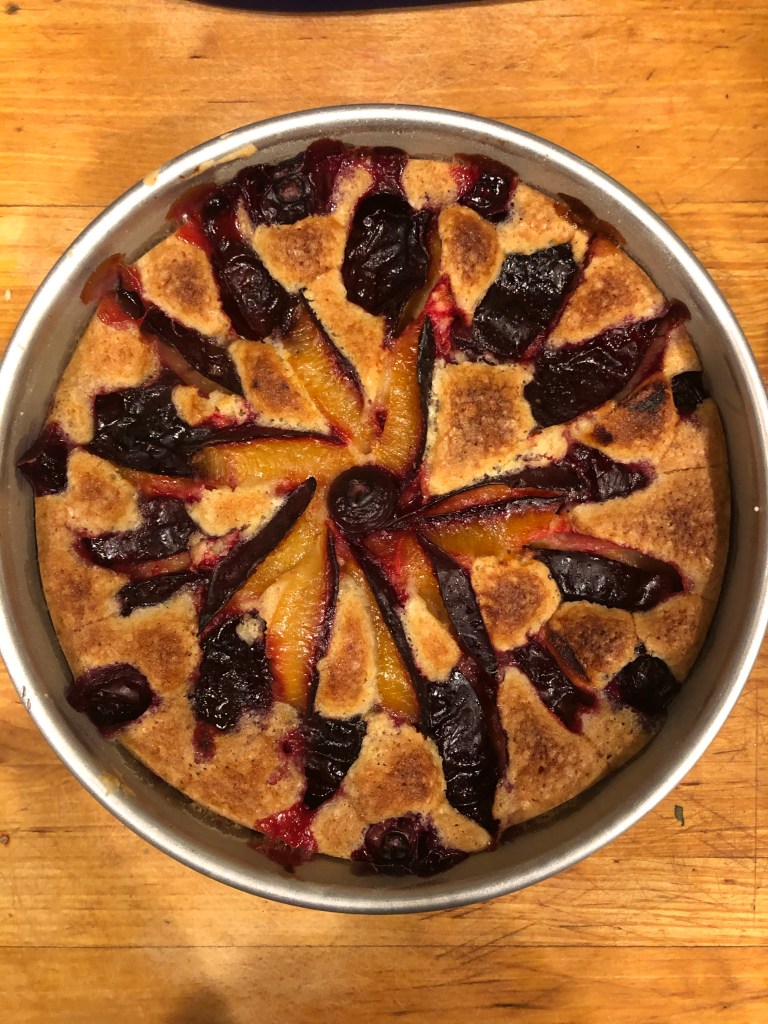
I’m not sure where I was when everyone else was learning how to make this torte, but now that I’ve figured it out, I just can’t stop making it. I can wait for my friend to have a baby so I can make her one, or to be invited to a party (maybe a year from now post pandemic?) when I can impress with my cooking prowess. Because this is an impressive looking cake and something you want to share.

INGREDIENTS

1/2 cup butter softened

3/4 cup of sugar

1 tsp vanilla

2 eggs

1 cup flour (I use a mix of all purpose, whole wheat, and ground almonds)

1 tsp Baking Powder

8 black plums

Pinch of cinnamon

1/4 – 1/2 tsp lemon

Preheat oven to 350 degrees.

Cut all the plums in half lengthwise and remove the pits. cut each half in half again lengthwise depending on the size of the plums. Take one plum and cut in thin slices to make a fan in the middle of your torte. Put all the plums in a bowl and toss them with a sprinkle of sugar, cinnamon to taste, and a squeeze of fresh lemon.

Meanwhile start creaming the butter, add the sugar, then vanilla, then eggs, one at a time. Mix the dry ingredients in a bowl and slowly add them to a greased 9” cake pan. The batter is kind of think and I used a spatula to spread it evenly around the pan.

The next part is the most fun, spreading the fruit in pretty patterns on top.

Pack the plums close together and arrange decoratively over the batter. Sprinkle a little sugar on the top before sticking in the oven.

My oven is a little hot and I turn it a little lower than 350 and cook for 45 minutes. I recommend checking on it at 40 minutes. The batter puffs up around the fruit which sinks into the cake. Let cool before eating!

Sheet-pan Harissa Salmon with potatoes and Citrus, by Colu Henry

Sheet pan harissa chicken has become a regular on our family menu and this recipe provides a refreshing alternative. I had a large salmon fillet (about 2 lbs) that I sliced in 5 two-inch wide slices, which I marinated in 3 Tbs harissa, 1 clove garlic, 2 Tsp ginger, 1/2 Tsp zest from one clementine, 1/4 cup orange juice while I prepared the other ingredients.

I cut up 4 smallish yellow potatoes into 1.5 inch chunks, and two small red onions. This is more than the recipe calls for but they are so good- why stick to one pound? Toss with olive oil and salt and pepper, then place on a sheet pan lined with parchment paper, leaving room for your salmon fillets.

Preheat oven to 450 degrees then roast the potatoes and onions for 20 minutes. At 20 minutes remove the pan from the oven then add the salmon, skin side down, and bake for another 8-10 minutes. Top with chopped scallions and cilantro. Enjoy!

Station Eleven: A Novel, by Emily St. John Mandel

This book could be the ideal or the worst book to read in the midst of a pandemic, depending on your anxiety level. The story takes place in a future present time, during the eruption of a “Georgia Flu” Pandemic and takes place primarily in the Great Lakes Region of the US and Canada. The Georgia Flu is more deadly than the Coronavirus – 4 hours from infection to the onset of symptoms and 1-2 days to death. In a short period of time 99% of the population dies. So either you could read it and be relieved that our Pandemic is not as serious as the Georgia Flu (which is how my book group colleagues responded) or you could read it and fear for the worst about your current situation.

The narrative starts on Day 1 of the Pandemic, with a performance of King Lear in Toronto, during which Arthur Leander (the actor playing the title role) has a heart attack and dies. Jeevan Chaudhary, an EMT and friend of Arthur’s, was sitting in the front row and rushes on stage to try to resuscitate him, but it is too late. As the EMT’s take the body away Jeevan leaves the theater and is wandering the streets of a snowy Toronto in a daze when he gets a call from a doctor friend about the Flu outbreak in his hospital. The doctor tells him to immediately pack and leave the city. Jeevan picks up on the urgency of his friend’s voice and buys 7 grocery carts of food and supplies to bring to the apartment of his handicapped brother Frank. The two ride out the beginning of the pandemic (and the death of Toronto) from his 10th floor apartment window.

The narrative leaps back and forth in time from the King Lear performance on Day 1 of the Pandemic, with occasional extra-diegetic warnings inserted such as “everyone at the bar will be dead in 2 weeks”. What seems like a random assortment of characters, we learn are in fact all loosely connected to Arthur. The story is like a fabric which comes unraveled and then is knitted back together by the end.

Among the characters from Arthur’s past are his first two wives, Miranda and Elizabeth. Miranda is an artist whose life passion is a graphic novel project about a space station named Station Eleven. The story within a story provides a sci-fi mirror to the otherworldly events on earth, and also serves as a device to connect characters. Station Eleven has rescued a group of earthlings from the planet’s natural destruction, but in their escape the station was damaged so it’s always twilight. Factions emerge among the Station Eleven inhabitants between those who want to return to Earth and those who know there is no return.

Another story within the story is the series of letters Arthur writes to his childhood friend “V”. V later sells the letters and publishes them. V never responds to Arthur’s letters so they become an autobiographical view on Arthur’s life.

The future narrative shows post-pandemic life – small towns become strongholds for rural living with collective security measures in place. The conductor of the army orchestra forms the Traveling Symphony which wanders from town to town performing music and Shakespeare. In the troupe is one of the child actors from Arthur’s King Lear performance. Another group of survivors have colonized an airport in Michigan. The group ends up at this small airport after their flights on Day 1 of the Pandemic were re-routed and grounded. Some of these passengers had been on their way to Arthur’s funeral in Toronto. A religious group following “the Prophet” travel from town to town terrorizing residents and stealing their weapons. This group also has a connection to Arthur which I will not spoil for my readers.

A delightful aspect of fiction is that in a world where 99% of humanity has succumbed to a virus, so many characters and plot lines can come together at the end. This is especially comforting from the perspective of a New Yorker stuck in a quarantine with no end in sight. The book also wraps up with a note of hope – Electricity has re-emerged in Chicago – a grid of streetlights appear on the distant horizon. Despite the devastating losses, humanity has preserved its knowledge and basic technology. Station Eleven is a beautifully written novel, and even if you must wait until after our own Pandemic to read it, it will be worth the wait. I rate this book  a 4.5 👍 out of 5👍.